
How to Actually Practice on a Golf Simulator (And Finally Understand Your Ball Flight)
If you’ve ever walked onto a driving range in Kansas City and just started hitting balls, you’re doing what most golfers do.
And it’s exactly why most golfers don’t get better.
According to Golf Digest, over the past 30–40 years, despite massive advancements in equipment, coaching, and technology, the average golfer has only improved by a few strokes—and average scores have largely stayed the same.
That tells us something important:
Most golfers aren’t actually practicing in a way that leads to improvement.
At All Seasons Indoor Golf Club in Kansas City, we see the same pattern:
Good swings
Solid contact
Decent ball flight
…but zero understanding of why the ball did what it did.
And that’s the difference.
Because simulator practice becomes powerful not because you can see ball flight…
…but because you can understand it.
The Real Goal of Simulator Practice
Most people think practice is about:
“Hitting it better” or “straighter”
It’s not.
We believe it’s about:
Understanding what controls your ball flight—and understanding your tendencies.
Because once you understand that, you can:
Fix things on the course
Make adjustments mid-round
Stop relying on “finding it” that day
The Problem: Practicing Without Cause & Effect
At a traditional outdoor driving range in Kansas City, you can see:
Start direction
Curve
Distance (kind of… depending on the ball)
But you don’t know:
Why it started there
Why it curved
Why one went 10 yards shorter
So what happens?
You guess. You reach for an answer
And guessing is not an improvement system.
Practicing using a golf simulator removes the guesswork—but only if you’re looking at, and most importantly - understanding, the right data.
The 4 Core Data Points That Control Ball Flight
If you take nothing else from this, take this:
Ball flight is the result of how the ball is spinning through the air.
And that spin is largely influenced by four things:
Face-to-target
Swing path
Dynamic lie angle
Strike location
If you understand these, you understand the results of your golf swing.
1. Face-to-Target (Start Direction)
This is the foundation of everything.
Where the face points at impact (along with dynamic lie) largely determines where the ball starts.
Face right (open to target) → ball starts right
Face left → ball starts left
Most golfers believe their swing path controls direction.
It doesn’t.
At our Kansas City indoor golf simulator, we show this every day:
You can swing left (outside-in) and still start the ball right
You can swing right (inside-out) and still start the ball left
Because:
The face is king when it comes to start direction.
2. Swing Path (Curve)
Now we layer in curvature.
We now know:
Face determines where the ball starts
Swing path relative to face determines how it curves.
The simplest way to remember it:
“Face sends it. Path bends it.”
What Swing Path Actually Means
Swing path is simply the direction your club head is traveling through impact.
For a right-handed golfer:
Inside-out path (I-O)
Club travels from inside → out toward the right
→ promotes draw spinOutside-in path (O-I)
Club travels from outside → in toward your body
→ promotes fade/slice spin
A simple visual:
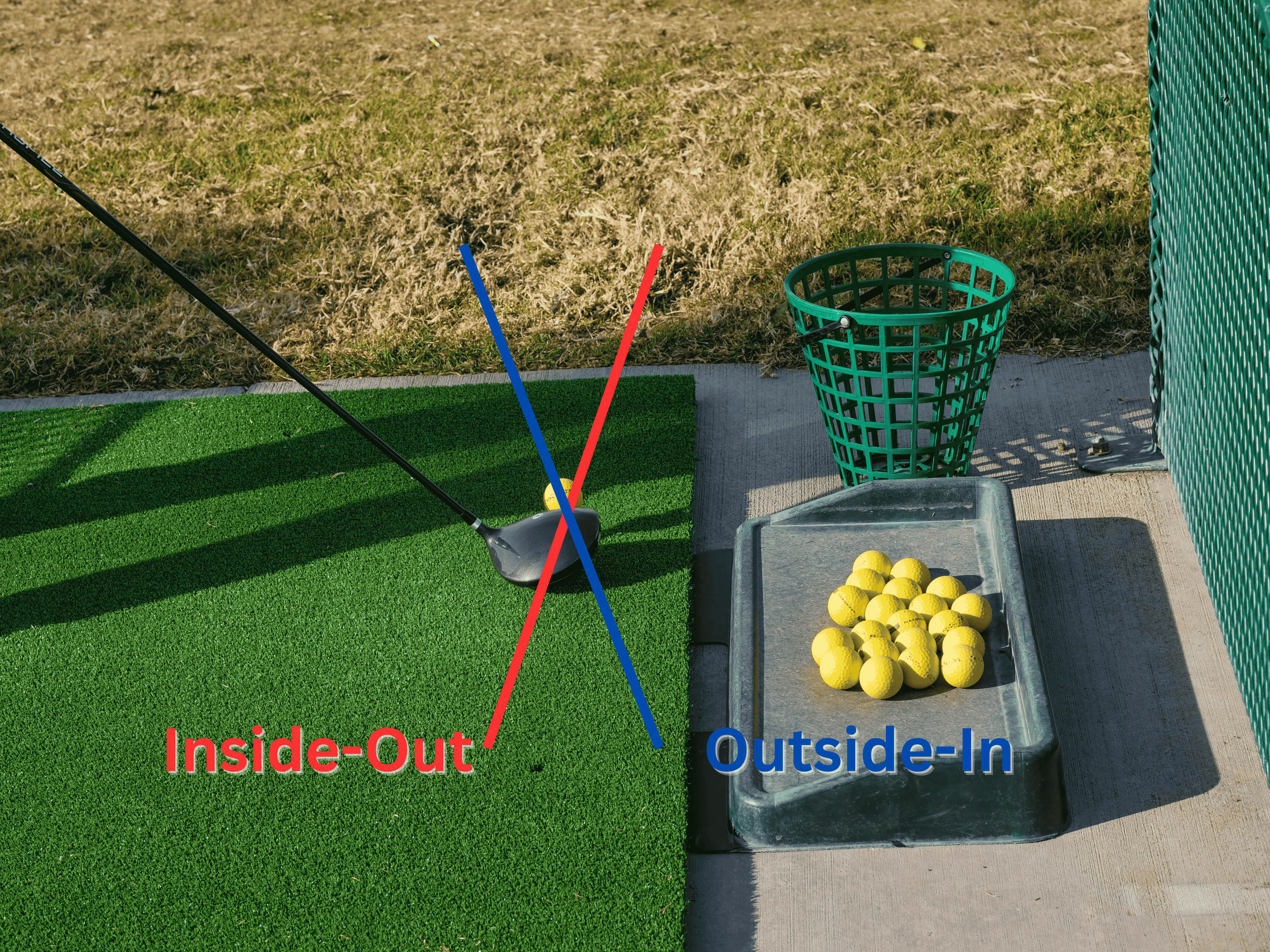
Think of a billiards ball—if you strike the right side of it, it spins left.
Golf works the same way.
Real Examples
Example 1: Push Draw
Face = 2° open to target
Path = 6° inside-out
Ball starts right → curves back left
Example 2: Push Fade / Slice
Face = 6° open to target
Path = 8° outside-in
Ball starts right → curves further right
This is where most golfers get lost on the driving range.
You see curve or the ball falling more time than not one direction…
But you don’t know what created it.
On a simulator, you do.
3. Dynamic Lie Angle (Your Hidden Start Line Variable)
This is one of the most misunderstood pieces of ball flight.
Dynamic lie angle can change where your face is actually pointing—even if your face angle number looks correct.
What It Means
At impact (not at address or standing still - this would be called ‘static lie’):
Toe up → face points left
Toe down → face points right
So you might hit a shot that starts left and think:
“I closed the face”
Then you look at your data:
Face = slightly open
Now you’re confused.
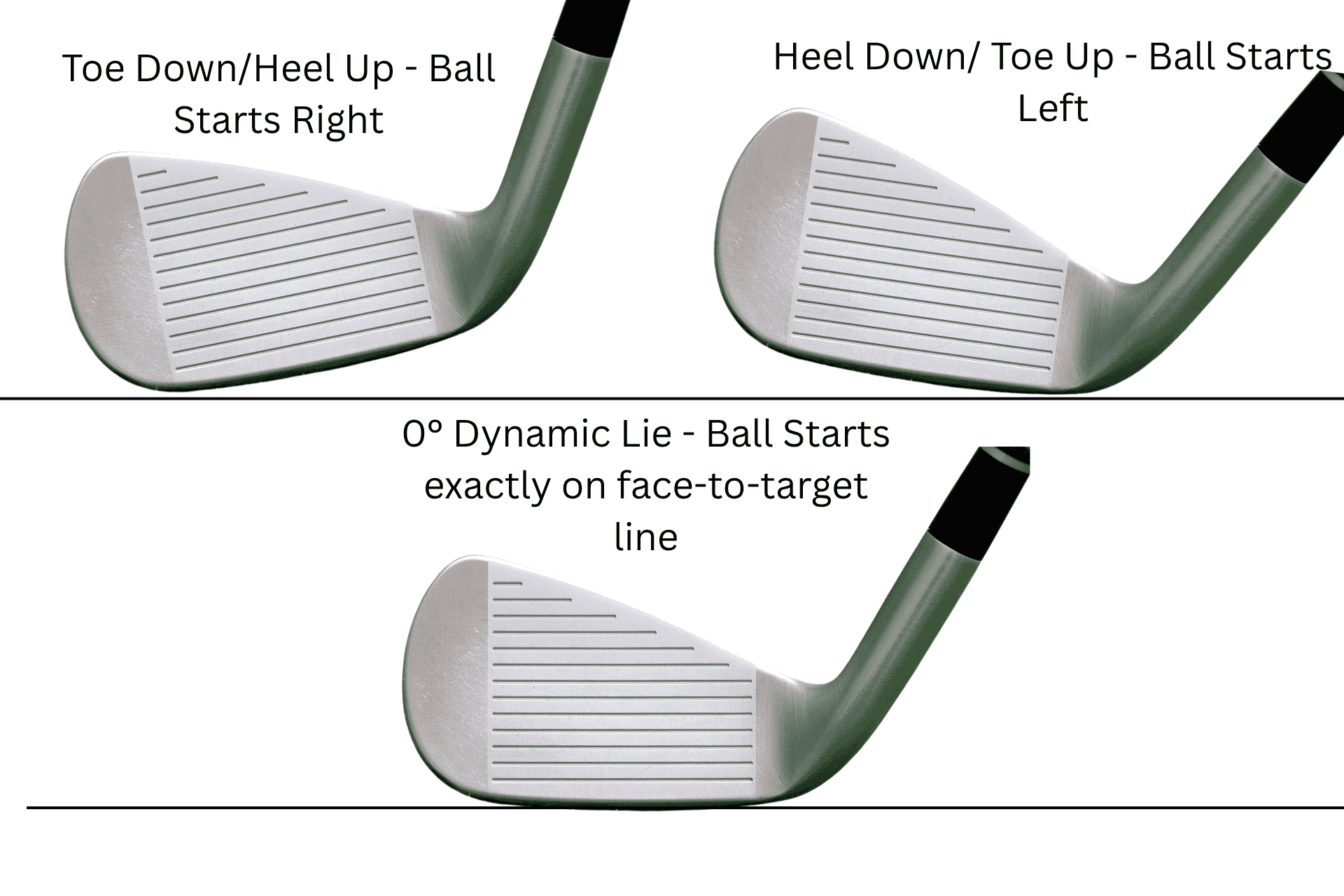
What Actually Happened
Your dynamic lie angle tilted the face left
This is why:
Club fitting matters over time and periodically having your lie angles checked on your already fit-for-you clubs.
Swing changes can affect your equipment fit
And this is something you simply cannot diagnose at a driving range in Kansas City.
But on a simulator?
It shows up immediately.
4. Strike Location (The Hidden Driver of Curvature)
This is the one almost nobody pays attention to—but it explains a ton of “that didn’t fly how I expected” shots.
Where you strike the face directly influences spin axis and curvature.
Most golfers think:
“Face and path = ball flight”
That’s mostly true… until strike location steps in and overrides it.
How Strike Location Changes Ball Flight
On modern drivers, woods, and hybrids, the face is designed to overcome ‘gear effect’—which means:
Toe strike → adds draw spin (ball curves left for a right-handed golfer)
Heel strike → adds fade spin (ball curves right)
So even if your numbers say:
Path = 6° I-O (inside-out)
Face = 2° O (right of target)
You’d expect to see a ball that starts right and falls to the left (or a push-draw).
But if that ball comes off the heel side of the club face?
It can:
Reduce the draw
Fly straighter than expected
Or even turn into a fade
That’s where golfers get confused.
They think:
“My path must not be what I thought”
When in reality:
Your strike location changed the spin.
Why This Matters More With Driver, Woods, and Hybrids
With game improvement irons, the effect is smaller. You’ll still see some influence, but it’s muted.
With:
Drivers
Fairway woods
Hybrids
Strike location is a major ball flight variable.
That’s why you can hit:
Two swings that feel identical
With nearly identical face/path numbers
…and get completely different ball flights.
Vertical Strike Matters Too
It’s not just heel vs toe.
High vs low on the face also changes things:
High face strike
Lower spin
More “floaty” flight
Can increase distance
Low face strike
Higher spin
Shorter carry
Less efficient flight
This is a huge factor in:
Driver distance inconsistency
“Why did that one go nowhere?” swings
A Critical Factor Most Golfers Ignore: The Golf Ball
Now let’s address something almost nobody talks about.
Your golf ball matters—a lot.
Even at a premium facility like All Seasons Indoor Golf Club, where we provide tour-quality golf balls…
Some of those balls:
Have been hit hundreds (or thousands) of times
Have lost compression consistency
Produce inconsistent spin and ball speed
Sound familiar?
It’s an even larger issue at a driving range.
What You Should Do Instead
If you want real results:
Bring your gamer ball.
The one you play on the course.
Because now:
Your distances are accurate
Your spin is reliable
Your dispersion patterns are real
How to Practice With This Information (Simple Framework)
Now let’s tie it all together.
When you step into a Kansas City golf simulator, your session should look like this:
Step 1: Pick One Variable
Not everything.
Just one:
Face control
Path consistency
Strike location
Step 2: Watch Cause → Effect
Instead of guessing, ask:
Where was my face pointed?
What was my swing path?
What did the ball do?
You’re building a feedback loop:
Data → Adjustment → Ball Flight
Step 3: Build Patterns (Not Perfect Swings)
You’re not chasing perfect.
You’re chasing:
Predictable start lines
Predictable curves
Predictable distances
Predictable misses
That’s what actually lowers scores.
Why This Doesn’t Happen at the Driving Range
At a typical Kansas City driving range, you:
Don’t know your spin
Don’t know your face angle
Don’t know your path
Don’t know your exact strike location on the club face
So improvement becomes:
Trial and error
At our simulator:
It becomes measured and repeatable
What This Means for Your Game
When you start practicing like this, everything changes:
You understand your miss instead of fearing it
You can understand issues mid-round
You stop overhauling your swing unnecessarily
You gain confidence because you know your numbers - and more importantly your tendencies of a poor strike.
Train Smarter at All Seasons Indoor Golf Club
At All Seasons Indoor Golf Club, we’re not just giving you a place to hit balls.
We’re giving you a way to:
Understand your swing
Control your ball flight
Actually improve
Ready to Stop Guessing?
Bring your gamer ball. Step into a bay. And start practicing with purpose.
Book your session at All Seasons Indoor Golf Club in Kansas City today.
